Editorial review: KSM Product Development Team · Updated 8 October 2026
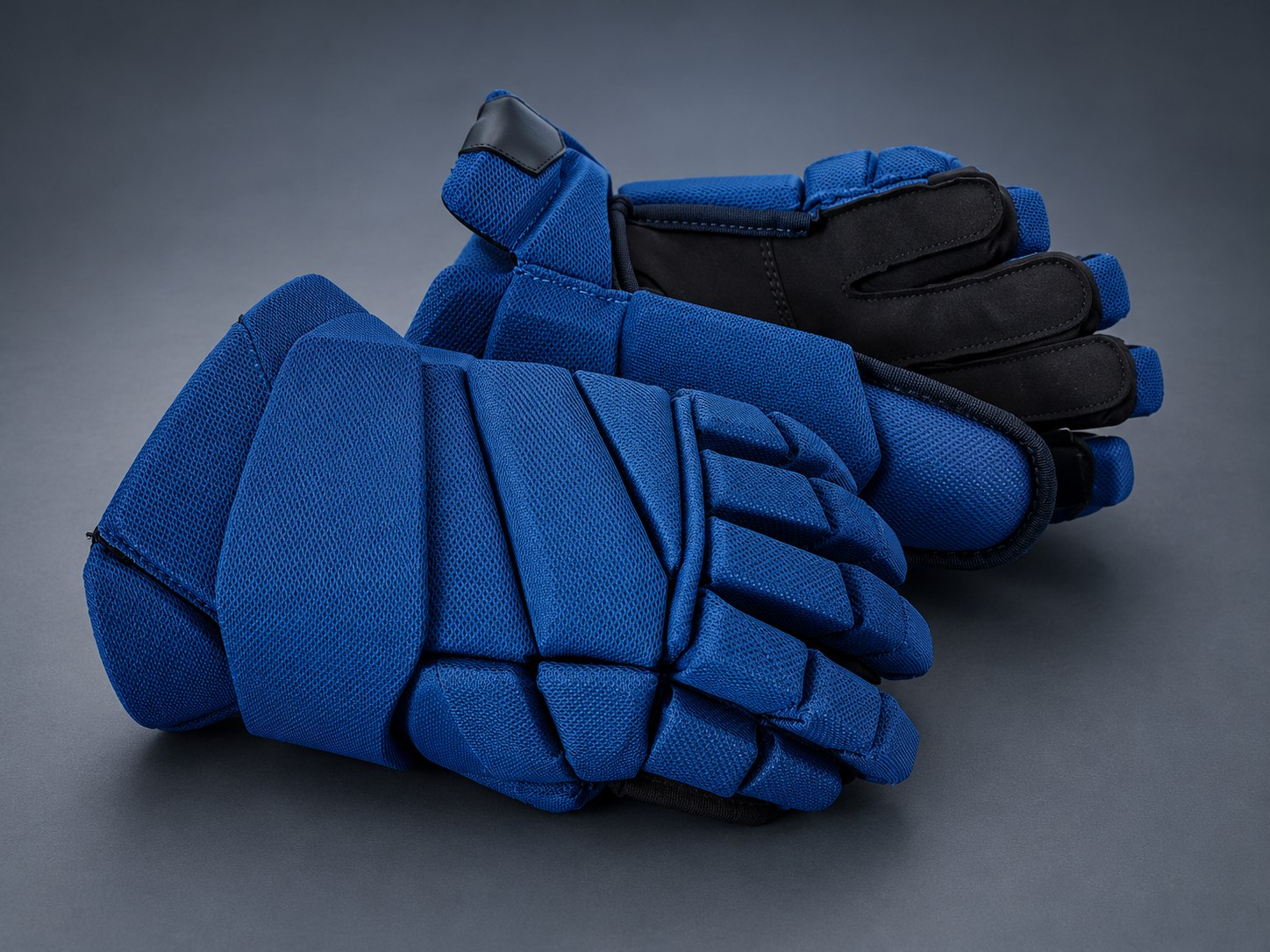
The cuff is often the clearest location for a team name, crest or player identifier. Backhand and side-panel zones can also work when the glove construction provides an uninterrupted area. Final placement must be checked against seams, padding segments, folds and the decoration method.
Start with product geometry, not a blank rectangle
A hockey glove is a moving protective product. Its visible surfaces are divided by padding rolls, finger segments, seams, cuff breaks and material changes. Artwork that looks clean on a flat screen can become distorted when placed across a seam or flex point.
Logo placement should therefore be chosen on the actual glove template or sample. The online sample room is useful for exploring a concept, but it is not a production specification.
Common branding zones
| Zone | Often suited to | Watch for |
|---|---|---|
| Cuff face | Team name, short wordmark, crest, player number or private-label mark | Cuff segmentation, wrist movement, available height and lettering length |
| Backhand panel | Compact crest or brand identifier where a clear panel exists | Padding rolls, curvature, stitching and visual interruption |
| Thumb / side area | Small secondary identifier or number | Limited area, movement, abrasion and legibility at distance |
| Interior label | Size, care, product information and private-label identification | Comfort, regulatory information and label durability |
| Palm | Usually not the primary visual branding zone | Grip, abrasion, reinforcement, seams and direct stick contact |
1. Decide what information deserves priority
Do not force the crest, full team name, player number, sponsor and manufacturer mark into one small zone. Establish a hierarchy:
- Primary team or brand identity
- Optional player identification
- Required product or private-label information
- Secondary graphic accents
A short wordmark may remain legible where a detailed crest does not. A player number can be placed consistently at a smaller scale if the team name already occupies the main cuff zone.
2. Supply production-ready artwork
- Preferred: editable vector files such as AI, EPS, SVG or print-ready vector PDF.
- Possible for review: high-resolution PNG with transparent background.
- Avoid as the only source: screenshots, social-media images, photographs of a logo or small JPEG files.
- Convert fonts to outlines or identify the licensed typeface.
- Include official color references and a monochrome version where appropriate.
- Confirm that the buyer owns or is authorized to use every submitted trademark.
3. Match the decoration method to the design
Decoration suitability depends on the material, logo detail, available area and product construction. Embroidery can give a dimensional team look but may not reproduce very fine details at small scale. Patches can organize complex artwork into a defined unit. Print or transfer methods may suit particular materials and graphics, subject to development testing.
Do not select a method only from appearance. Review flexibility, edge finish, abrasion exposure, added stiffness and how the application affects the underlying panel.
4. Approve the logo on the sample
- Check scale from both close range and normal rink distance.
- Confirm that lettering remains readable when the cuff bends.
- Look for seams or padding breaks passing through key artwork.
- Compare left and right glove placement.
- Confirm colors under more than one lighting condition.
- Record the approved position with dimensions or a controlled artwork template.
Common logo-placement errors
Artwork becomes unreadable
Simplify small elements or use a compact alternate crest.
Edges cannot be reproduced cleanly
Provide vector artwork instead of enlarging a screenshot.
The logo breaks across construction
Move or resize the artwork on the actual product template.
Trademark use is unclear
Only submit team, sponsor or brand artwork you are permitted to use.
Hockey glove branding FAQ
Can each player have a different name or number?
Player-level identification may be possible, but the placement, file setup and roster control must be agreed before approval. Treat every variable field as part of the order matrix.
Can a detailed crest be embroidered at a very small size?
Fine lines and small text may need simplification. The final method and minimum reproducible detail should be evaluated from artwork and a physical sample.
Can we upload an NHL or commercial brand logo?
Only if the buyer has authorization. KSM should not reproduce third-party trademarks without documented permission.
Preview your colors and logo position.
Create a concept, then submit the artwork for technical review.